FINALLY MAKE SENSE OF “SE”.
Unlocking “SE” Verbs in French

€180
One-time payment
✓ 5-day self-paced course
✓ Recorded video lessons
✓ Worksheets, resources & quizzes
✓ Lifetime access
Why does “se” show up everywhere in French?
Spend even a few minutes listening to French and you’ll hear it constantly:
Je me suis dit…
On s’en occupe.
Ça s’est bien passé.
Tu t’es trompé.
On se voit demain.
Some of these verbs are reflexive. Many aren’t.
And that’s where things can get confusing.
Rather than memorizing se verbs one by one, this course will help you understand the patterns behind them — what se is doing, how these verbs behave, and why French speakers use them the way they do.
Go from recognizing “se” verbs to actually knowing how to use them.
We’ll break pronominal verbs down in plain English, then build them back up through the French you’re likely to encounter in real life.
You’ll learn how to recognize different types of pronominal verbs, conjugate them across tenses, choose the right pronouns, and understand the subtle changes in meaning that se can create.
The goal isn’t simply to learn another grammar rule.
It’s to make a huge part of everyday French finally click.
What you’ll learn
Throughout this course, we’ll unpack the intricacies of French pronominal verbs, focusing heavily on their everyday use, conjugation, and subtle nuances. From reflexive to reciprocal and idiomatic uses, you’ll learn to identify and use these verbs with greater confidence in both conversation and writing.
With thorough breakdowns in plain English and step-by-step sentence building, you’ll gain a deeper understanding of how the different types of “se” verbs really work — and, most importantly, how to apply what you’re learning in real life.
You’ll learn:
How to use “se” verbs to talk about past, present, and future actions — and conjugate them confidently across different tenses.
How to use the pronouns y and en with pronominal verbs to sound more natural, avoid repetition, and simplify your sentences.
How reflexive, reciprocal, and idiomatic pronominal verbs differ — so you understand what se is actually doing rather than simply memorizing verbs.
How the addition of se can subtly — or completely — change the meaning of a verb, and how to recognize those differences in real French.
How to make sense of the trickier grammatical rules surrounding pronominal verbs — including some that even native French speakers are known to have trouble with.
Understanding pronominal verbs is like holding a key to deeper meaning in everyday French. Once you understand the patterns behind them, you’ll start recognizing them everywhere — and using them with far more confidence yourself.
French makes more sense when you understand the logic behind it.
As someone who learned French myself, I remember how confusing pronominal verbs seemed at first. They’re often introduced as “reflexive verbs,” only for you to discover that French uses se in all sorts of situations that don’t seem reflexive at all.
So I designed this course around the explanations I wish I’d had: clear patterns, comparisons with English, and lots of examples of how French speakers actually use these structures.
My goal is for you to finish the course understanding the system — not just having memorized more verbs.
Everything you need to make it stick.
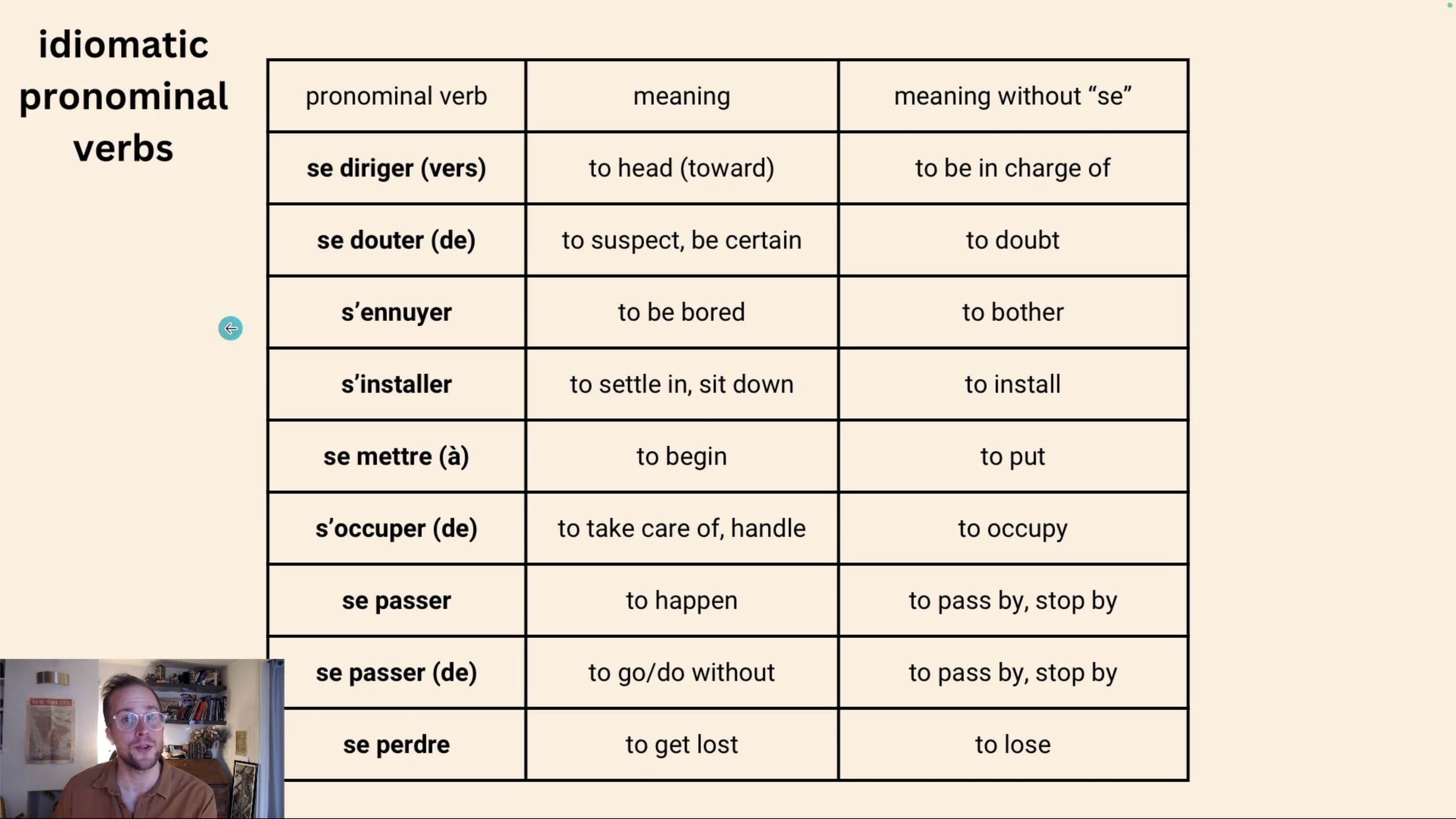
Recorded video lessons
Printable worksheets to put what you learn into practice
PDF resources you can return to anytime
Quizzes to reinforce what you’ve learned
Self-paced learning
Lifetime access

French explained by someone who’s learned it, too.
I’m Alex, the creator of Alex Teaches French.
I’m a native English speaker who learned French myself—and that’s a huge part of how I teach.
I know which French concepts don’t translate intuitively into English because I’ve had to make sense of them myself. Rather than asking you to memorize another collection of grammar rules, I break French down through the perspective of an English speaker and show you how it actually works in everyday life.
That’s exactly how I approached this course: helping you understand the logic behind pronominal verbs, rather than simply memorizing which verbs happen to use se.
€180
Frequently Asked Questions
-
This course is designed for learners who already have a foundation in French and want to move beyond textbook French toward more natural, nuanced expression.
-
The course is designed to be completed over 5 days, with video lessons, resources, worksheets and quizzes throughout. It’s completely self-paced, so you can follow the 5-day structure or take as much time as you need.
-
You’ll have lifetime access, so you can revisit the lessons whenever you need a refresher.
-
The course is taught primarily in English, with plenty of French examples throughout. Everything is explained from an English speaker’s perspective, so you can understand how pronominal “se” verbs actually work in everyday French.
-
After enrolling, you’ll get instant access through Teachable, where all Alex Teaches French courses are hosted. You can access anytime from your computer, tablet, or phone.
-
Because I’ve been in your shoes.
I learned French as an English speaker, so I know what it’s like to hesitate mid-sentence, translate too literally, struggle with concepts that don’t exist in English, and wonder why French works the way it does.
A native speaker knows French instinctively. I had to learn why it works—and how to make it make sense from an English-speaking perspective.
That experience shapes the way I teach. I can anticipate where you’re likely to get stuck because I got stuck there too, and give you the explanations and shortcuts I wish I’d had along the way.
My goal isn’t to replace learning from native speakers. It’s to help you bridge the gap between learning French and actually feeling like yourself when you speak it.
Ready to make sense of “se” verbs?
Start actually using them in everyday French.
€180 · Lifetime access